Dobare — Merchant Panel
A responsive merchant workspace for running customer loyalty: customer and order operations, segmentation, campaigns, automated journeys, wallet management, surveys, and actionable reports in one product.
Overview
Dobare gives businesses one operating surface for turning customer activity into repeat sales. The merchant panel connects daily work — customers, orders, credit, communication, and feedback — with the reports needed to understand what is working. I have built and evolved major parts of this product across frontend architecture, reusable workflows, responsive RTL interfaces, and, later, full-stack delivery.
An operating cockpit for merchants
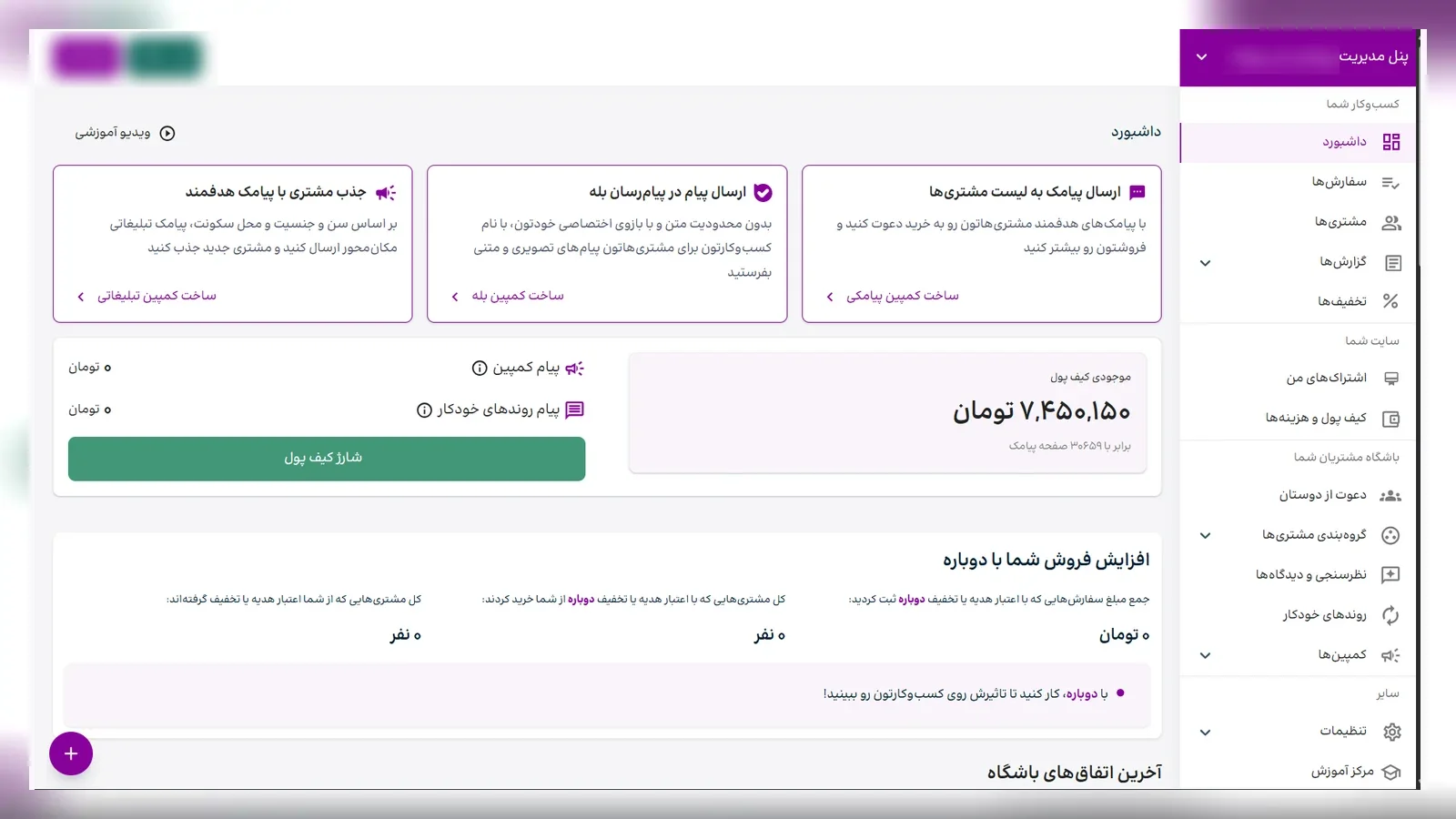
The dashboard brings the next useful actions forward: launch a targeted campaign, send through connected channels, fund the messaging wallet, and review the effect of loyalty credit. Navigation keeps a broad product surface understandable even as the panel grows across customer, report, campaign, and configuration modules.
Customer and order operations
Customer records and order history form the operational base of the loyalty program. Merchants can search, filter, label, and group customers; inspect purchase context and wallet balances; work with orders; export operational data; and import an existing customer list through a guided mobile-friendly flow.
- Search and filter customers by activity, score, purchase history, labels, and segments
- Review order status and operational details, with sorting and spreadsheet export
- Import existing customer lists with format guidance and validation
Campaigns and automated journeys
The communication tools move beyond sending one message to everyone. Merchants can choose a customer segment or upload recipients, select a delivery channel, schedule or gradually release a campaign, attach loyalty credit, and reuse automated journeys for repeatable moments in the customer lifecycle.
- Target customers through custom segments, scores, labels, and purchase behavior
- Build campaigns for SMS and connected messaging channels
- Schedule delivery, control release pace, and include gift credit when needed
- Automate membership, order, survey, profile, occasion, and credit-reminder journeys
Reports that connect activity to outcomes
Reporting is designed around decisions rather than raw tables. Merchants can compare acquisition and repeat-purchase patterns, inspect performance by week, day, or hour, follow loyalty-credit impact, and study survey satisfaction from an overview down to individual questions. The same information remains usable on desktop and mobile.
- Compare customer acquisition, return, and repeat-purchase performance
- Explore sales by week, weekday, and hour to find useful operating patterns
- Measure survey participation, satisfaction groups, and question-level results
Product engineering across a broad surface
- Built and maintained more than 15 configurable product modules while keeping navigation, states, forms, tables, charts, and feedback patterns consistent
- Designed reusable responsive components for dense desktop workflows and focused mobile tasks
- Contributed to a Module Federation architecture that supports independently delivered frontend surfaces
- Added unit and integration coverage with
JestandReact Testing Library, exceeding 80% on critical user journeys - Extended ownership from frontend architecture into
Python,Django, andPostgreSQLdelivery as the role grew
My role
I joined Dobare as a Frontend Developer and built complete product journeys from authentication and reusable interface foundations to complex tables, forms, campaigns, automation, and responsive reporting. My role later expanded to full-stack work, letting me carry features from data and API decisions through to the interface while keeping enterprise implementation details private.